


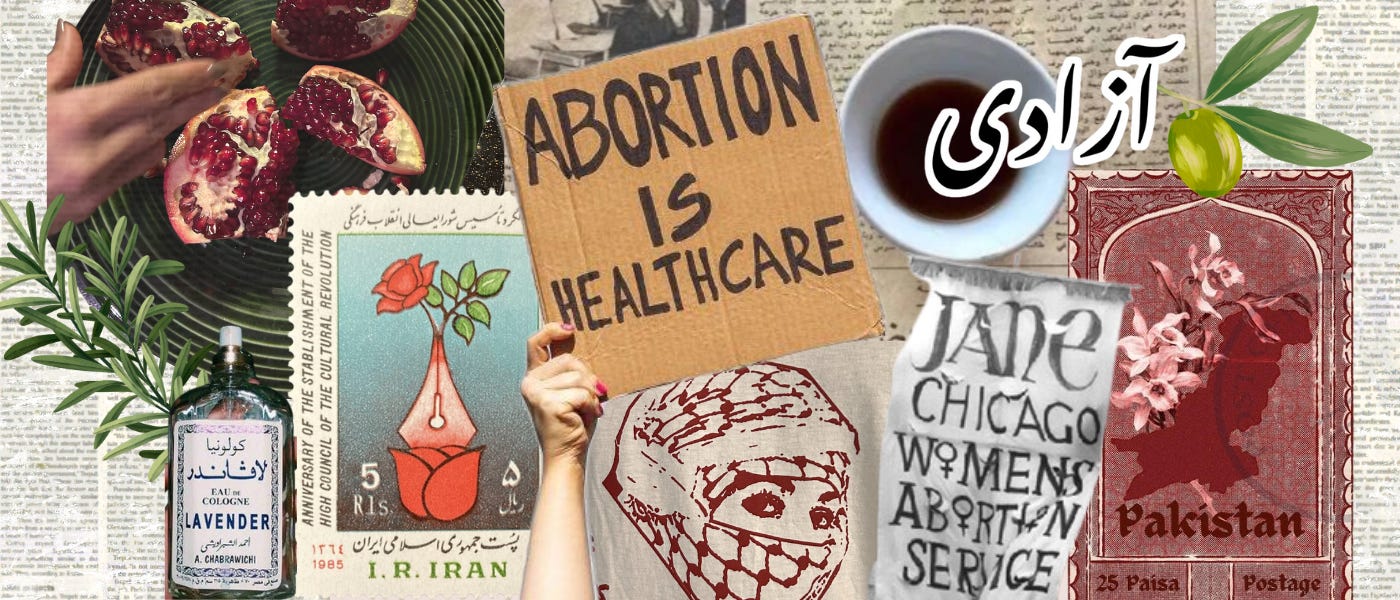
Women across the globe, from the villages in Karachi to the streets of Isfahan, have relied on the kinship of their communities for access to abortion. Long before the medicalization of abortion, it was the passing of sacred knowledge and an herbal approach to care that women relied on for their sexual and reproductive health. Much of this Indigenous history has been downplayed by Western medicine, but as brown women in the diaspora who work in the reproductive justice landscape, we feel it’s vital to not only preserve this knowledge but ensure it’s widely accessible. Between the continual attacks on bodily autonomy and the criminalization that disproportionately affects women of color, it’s about time we return to a network of collective care. Given what little consideration men in power have for our reproductive livelihoods and the threats of Project 2025 that’ll follow a Trump presidency, we cannot rely on the state.
Living in the South as women of color, it feels more practical and empowering to spread knowledge and awareness of how we can take care of our own reproductive health outside of institutions. Far before the overturn of Roe, which decimated abortion access across the country, people in the South were already having their right to access care chipped away little by little. In Texas, House Bill 2 effectively caused about 70% of abortion clinics to shut down between 2013-2016. It’s also in rural areas and Southern states where getting to a clinic that offers a range of contraceptive options is sparse, and it would benefit communities of color in particular to have their own resources and accessible natural methods. More broadly, it’s necessary to acknowledge the serious gap in medical research about women’s bodies. Gender inequality and bias have been persistent issues since the early days of biological and medical research. For instance, it wasn't until after 1986 that including women as subjects in clinical research became a standard practice. We know that women’s bodies function differently from men’s, yet in 2020, only 5% of global research funding was allocated to women’s health research. In part, this connects to a social stigma in the West of women-centered “conditions,” like menstruation.
Most women we know have experienced hiding a pad or tampon for discretion, or religious-based norms that are instilled about periods making them “dirty.” This socio-cultural shame and stigma has an impact— it leads to many women not having adequate resources to know how to manage their cycles effectively, or dealing with the life-hindering effects of PMDD or endometriosis, often going years before getting diagnosed or receiving treatment from a doctor. That’s why it makes sense that lately, we’re noticing a rise in women talking about their cycle phases or sharing their stories about PMDD. Ultimately, this can be a matter of life or death as we’re seeing more reports of pregnant women dying from complications in states with abortion bans, and maternal mortality disproportionately affecting Black women is at crisis levels.
It shouldn’t be surprising that women have to take a lot into their own hands to manage their health when these systems continuously harm us and let us down.
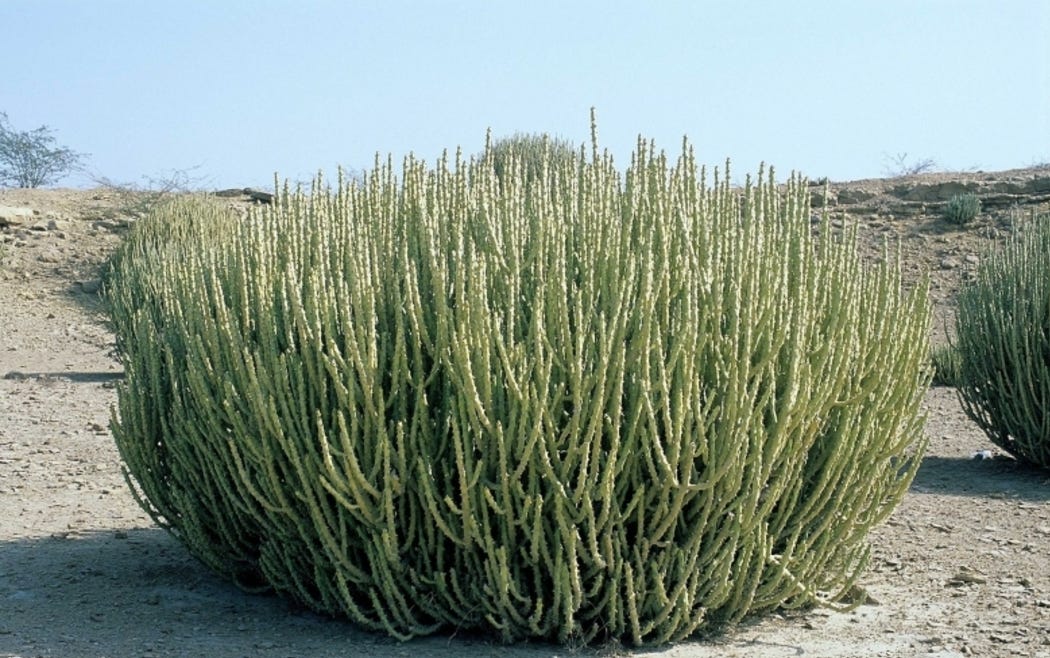
Much like the time-old Pakistani tradition of drinking haldi doodh (turmeric milk) as a cure for any ailment, the effectiveness and rich history of herbal medicine can be traced so far back across the globe. Community leaders, herbalists, and traditional birth workers in many rural communities are beacons in the realm of sexual and reproductive healthcare where industrialized medicine doesn’t have as strong a dominance. Crushed, extracted, or soaked in water overnight, an entire study, ethnopharmacology, deals with the relationship between people and indigenous vegetation for healthcare. A lot of the world’s population is still reliant upon materials gathered from the Earth to care for their bodies, ease menstrual cycle pain, serve as preventative birth control, and even administer abortions. Pakistan’s geographical terrain and climate habitats are full of flora that my ancestors have used for centuries. For example, in the Samahni Valley, nestled amidst the Pakistani and occupied Kashmir border, euphorbia caducifolia, or danda thor, has been used as a safe and effective abortifacient for centuries. Root decoction - the process of boiling plant roots in water to extract their chemical compounds - is but one illustration of the ingenuity and resilience of Indigenous communities to protect one another.
To me, the ability to call a trusted elder for my reproductive needs not only seems accessible but preferred above trusting the medical-industrial complex (more on this later).
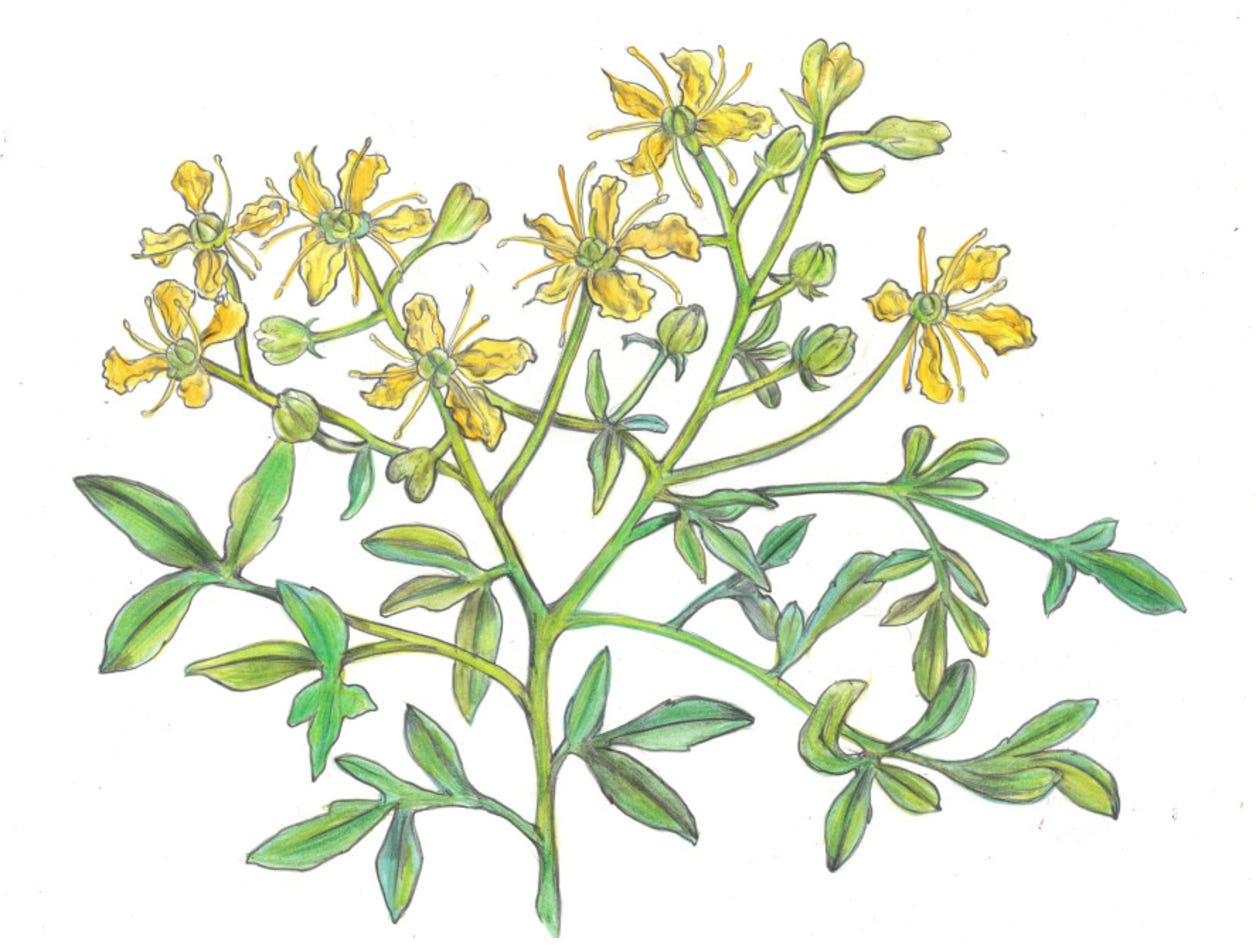
Today when people think of Iran, they often think of its restrictive Islamic government due to news headlines, but Iranians have long used traditional remedies to cure all kinds of ailments regardless of government or legality. Herbs have been used as medicine for centuries and are still strong today. In fact, their continued popularity isn't a sign we're stuck in the past — it's a reminder that plants are an essential part of modern medicine. Around 25-30% of today’s prescription drugs are made from plant-based compounds. Iranian medical texts say that a variety of plants have contraceptive properties, with some like Ruta graveolens, Ricinus communis, Piper nigrum, and Physalis alkekengi being particularly effective. Iran’s trade with the Balkans and China brought a variety of herbs and plants, and the country's vast and varying landscapes make it easy to grow nearly anything. A typical cup of tea, for example, can be enhanced with herbs that have contraceptive effects, from knowledge that has been passed down from generation to generation. This enduring tradition not only highlights accessibility but also the resilience of Iran’s cultural heritage which underscores the relevance of plant-based medicine in a world increasingly looking to natural solutions for health and wellness.
More recently, in post-revolutionary Iran, the culture has shifted in a way that people rely on underground networks for a number of things deemed illegal by the government, from accessing Western movies and music or using a VPN to get on the internet to making or buying alcohol. Therefore, it’s not difficult to imagine the same is happening for access to contraceptives and abortifacients. People have relied far more on each other than institutions, which also speaks to the collectivist culture overall. Not too different from what it’s like in rural and Southern states in the U.S., abortion in Iran today is restricted but women still need and get them, either within the medical systems (if they’re married) for things like fetal anomalies or to save the mother’s life, or outside of it through midwives or other resources in their communities. Ultimately, a fact that transcends borders is that criminalizing abortion doesn’t stop women from needing and getting them.
It’s a shame that the Westernization of reproductive healthcare, meant to help and heal the very people it also harms, has left a legacy of devaluing and discrediting herbal medicine. Communities across the global south still don’t have access to their full spectrum of sexual and reproductive healthcare, which is precisely why women have historically relied on their networks of trusted elders for abortions, contraceptives, pain management, and much more.
Capitalism, by design, keeps us reliant on pharmaceuticals instead of herbal remedies. If you stop to think about the power of equipping our societies with the knowledge in herbal practices needed to merely lessen our reliance on pharmaceuticals, it would hit big pharma right where it hurts. When a society is constructed on the principle of putting profit over people, naturally, a negative perception of holistic medicine has pushed us into a corner of distrusting centuries of Indigenous practices within our own ancestry. This is not meant to encourage people to put blind faith into any substance, please seek out trusted sources, but thousands of years of ethnomedicinal knowledge is so relevant in a post-Roe society.
We often forget to pause and consider why Indigenous and other communities of color are distrusting of the medical-industrial complex to begin with, especially in the context of their sexual and reproductive healthcare needs. Planned Parenthood, which is still seen as our leading hub for all things related to reproductive healthcare, can trace its roots back to a nurse named Margaret Sanger, who was a staunch eugenicist.
Although Planned Parenthood has denounced its ties to Sanger, it’s still important to contextualize the deeply racist history of gynecology and the validity of Black, Indigenous, and other people of color having a negative or fearful outlook on Westernized reproductive healthcare. Sanger was so intent on advocating for birth control, specifically for non-white women, that she aligned herself with the Ku Klux Klan, speaking at a rally in 1926. She also endorsed the 1927 Buck v Bell decision that allowed the state to forcibly sterilize anyone deemed “unfit” without their consent (which often included poor people, Black women, and immigrants). This is but a fraction of what women have endured before the onset of the reproductive justice movement and as a result, women turned towards a more communal approach to getting their sexual and reproductive healthcare needs met: hidden forms of birth control, underground abortion provision methods, and more. It’s also important to note that Planned Parenthood has a legacy of harming women of color, centering white feminism, and more broadly aligning themselves on the wrong side of history. Not only have they purported genocide denialism in the last year with their lukewarm statement on the “Violence in Israel and Gaza,” but it was also revealed by Prism Reports that Planned Parenthood contracts with Raytheon, an arms manufacturer that’s directly complicit in the genocide in Gaza.
Returning to this concept of reproductive mutual aid, which increasingly seems more necessary with the threat of Project 2025 on our horizon and the increase in surveillance and criminalization of people seeking abortions, I’d like to plug a revolutionary organization that I’ve drawn a lot of inspiration from: The Jane Collective. In the late 1960s and early 1970s, before Roe v. Wade protected the right to abortion, a group of young radical (white) women formed a covert underground network to help women obtain abortions. The Jane Collective was advertised in school newspapers and across Chicago and earned a reputation as a beacon of hope. Their approach to sexual and reproductive healthcare was steeped with respect, autonomy, and dignity—all values women have not historically felt within Western reproductive healthcare. Referred to as “the Janes,” the collective operated on a sliding scale fee system, ensuring patients weren’t turned away due to financial restraints. It’s estimated that the Jane Collective provided safe abortions for over 11,000 people!
In the early stages of the Janes getting their footing, they had licensed and non-licensed male practitioners perform the abortions, but as Jane grew, volunteers continued to pour in. Broader conversations were had on the importance of the Janes reclaiming as much reproductive power as possible, which eventually prompted many members of Jane to learn to perform abortions themselves. In 1972, police arrested seven Jane members, but the charges were dropped following the Supreme Court’s 1973 Roe v. Wade decision. The legacy of the Jane Collective stands as a powerful example of the power of direct action and the power of collective care. A different future is possible when we take community care and mutual aid into our own hands. We see this legacy continued today with abortion funds across the country that aid people traveling to places where they can still legally obtain abortions despite the cost, distance, or any other restrictions that disproportionately affect women of color. I feel so lucky to be part of this legacy.
Part of a statement from the Jane Collective:
Only women can bring about their own liberation. It is time for women to get together to change the male-made laws and aid their sisters caught in the bind of legal restrictions and social stigma. Women must fight together to change the attitudes in society about abortion and to make the state provide free abortions as a human right.
It’s difficult not to feel an overwhelming sense of defeat with the continual attacks on our reproductive self-determination. Where we live, abortion is completely illegal, and we have seen first-hand the devastating impacts it’s brought to our communities— from our homelands to Houston, Texas. The anti-choice extremists have been even more emboldened in their pursuit of controlling women’s bodies, but by studying our histories, we understand that it’s up to us to keep each other safe. Our commitment to sharing what we’ve learned within the reproductive justice movement with you all stems from a pursuit to deepen our connection to radical community care. Alongside dedicated leaders, birth doulas, educators, activists, and abortion funds, we are tasked with building a collectivist society as a form of resistance against oppression. This shift can affirm our right to make choices about our own bodies outside the confines of government and whatever fascist is currently in power.
All of this is to say: women will continue to need abortions and contraceptive care, and it’s time to get very comfortable with organizing outside the system. Learn about the ethnopharmacology in your area, donate to your local abortion fund, and know that you’ll always have options when we have each other’s back.
So, what’s next?
Check out @holistic.abortions if you’re interested in workshops on holistic reproductive practices.
Here’s a zine on Reclaiming Our Ancient Wisdom: Herbal Abortion Procedure and Practice for Midwives and Herbalists.
Listen to this two-part podcast series on The Jane Collective if you want to feel as inspired as we do to plug into direct action.
Learn how wild carrot seed can be (safely) used as an herbal contraceptive.
Abortion resources:
If you need an abortion and live in a state where it’s banned, visit ineedana.com or abortionfinder.org
Contact your local abortion fund [National Network of Abortion Funds] if you need financial or logistical assistance
If you’d like to self-manage your abortion at home and need abortion pills, visit: plancpills.org or aidaccess.org
Keep your digital blueprint in mind, here’s a zine with a step-by-step guide on abortion privacy + safety.
Books on herbal reproductive care:
Herbal Healing for Women by Rosemary Gladstar
Botanical Medicine for Women’s Health by Aviva Romm
Natural Healing in Gynecology by Rina Nissim
Taking Charge of Your Fertility by Toni Weschler
Books on reproductive justice, the racist history of gynecology & intersectionality:
Radical Reproductive Justice edited by Loretta J. Ross, Lynn Roberts, Erika Derkas, Whitney Peoples, and Pamela Bridgewater Toure
Take My Hand (Novel based on real events) by Dolen Perkins-Valdez
The Movement for Reproductive Justice: Empowering Women of Color through Social Activism by Patricia Zavella
Revolutionary Mothering: Love on the Front Lines edited by Alexis Pauline Gumbs, China Martens, and Mai’a Williams & preface by Loretta J. Ross
Medical Bondage: Race, Gender, and the Origins of American Gynecology by Deirdre Cooper Owens
Reproductive Rights as Human Rights: Women of Color and the Fight for Reproductive Justice by Zakiya Luna
also the planned parenthood critique like someone finally said it!!! 😮💨
so freaking interesting and nformative, i can't wait for more!!!! 🥹👁️👁️